
ETH Zurich Case Study: Teaching AI literacy at scale
How a first-year undergrad course at a world-leading institution used Rflect to address the thorny issue of student AI use and taught them critical judgement, with strong learning outcomes and a teaching approach now scaling toward a full curriculum
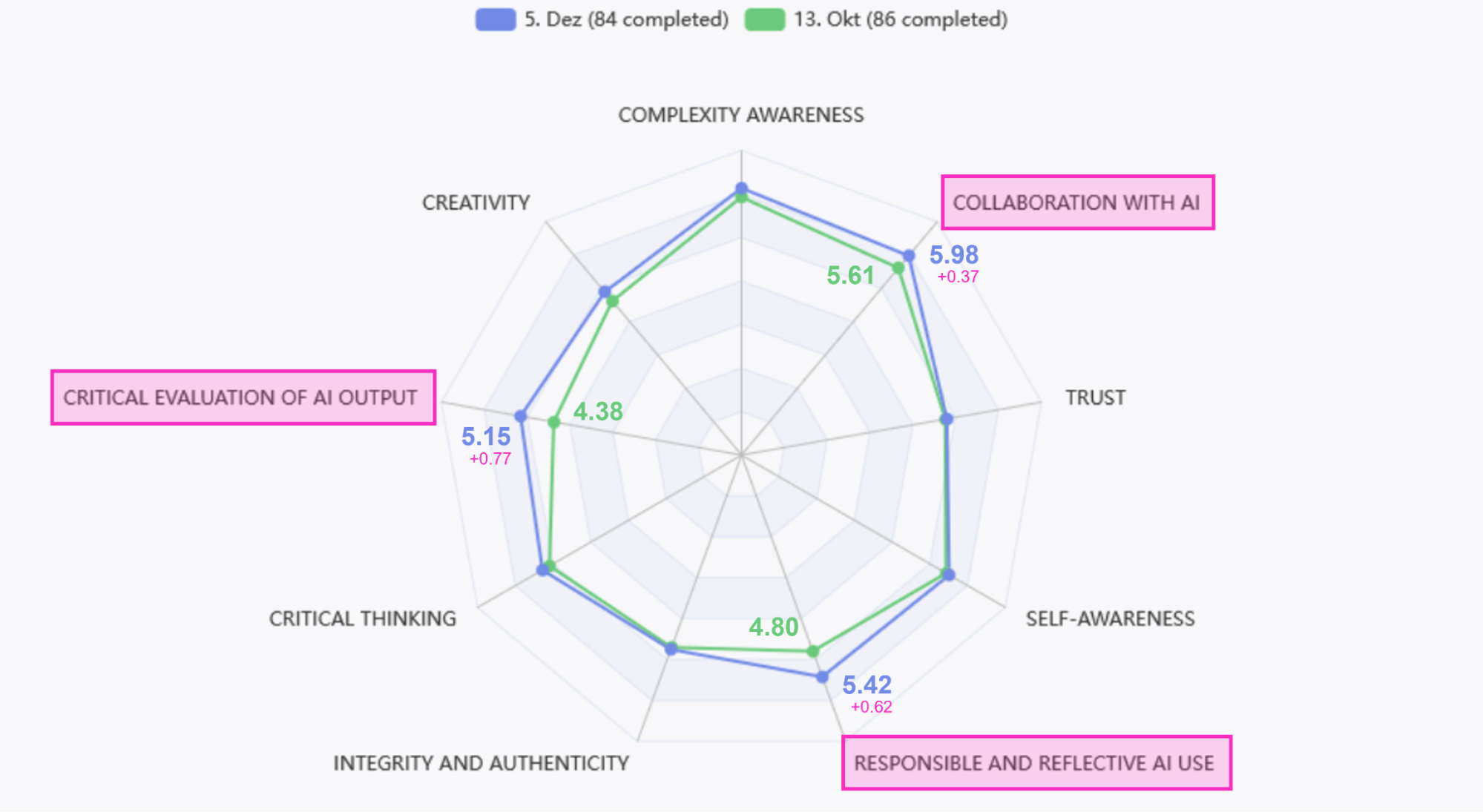
Student self-assessment results on AI competences from the Rflect pilot at ETH Zurich, autumn 2025.
For three years, Manuel Sudau and Katrin Wolf ran an AI exercise for first-year students at ETH Zurich, and for three years the question arrived in their inboxes in the same form: “Am I allowed to use AI for this?” Last autumn, those emails stopped.
Why? A hundred students were now asking the question of themselves, in the moments just after they had used AI, and reflecting on it in writing, week after week, for an entire semester.
Every university is currently grappling with how it will teach responsible AI use, and most of the early answers have taken the form of documents: policies, guidelines, academic integrity statements. The pilot ETH ran in its World Food System course in autumn 2025 took a different route. It paired a deliberately designed AI experience with structured reflection delivered through Rflect, which treated AI literacy not as a rule to be communicated but as a judgement to be practised.
Read on for:
- The challenge: why 100 anxious students needed more than another AI guideline
- The pilot design: how a 13-week course went live two months after the decision
- The outcomes: 95% completion rate, gains across nine inner competences
- The vision: a plan to scale from one course to a curriculum-wide reflection architecture by 2028
The challenge
The World Food System is a mandatory first-year course, led by Bruno Studer, and serving around 100 students each autumn across three bachelor programmes: Food Sciences and Nutrition, Environmental Sciences, and Agricultural Sciences. Since 2023 it has carried a voluntary AI learning element, co-developed by Manuel Sudau and Katrin Wolf, departmental staff whose role is educational and curriculum development and who see this cohort in person only once or twice a semester.
The element grew out of a departmental project Sudau launched in January 2023, weeks after ChatGPT’s release, exploring AI’s implications across 18 courses. His hypothesis was that ultimately no course would be untouched, because students would use AI for everything. The surveys and interviews that followed confirmed this instinct, with a twist that should interest anyone designing AI policy: students were not reckless adopters but anxious ones. They held back because they didn’t know the boundary conditions; what was allowed, what was possible, and what was wise.
The instinctive institutional response is more guidance. Sudau is blunt about its limits: “No one reads it in an age where the students are struggling to look at a Reel for more than one second.” The team’s conclusion was simple: written instructions cannot frame an experience in advance, but a well-timed question can frame it afterwards.
Key takeaway: Students were not reckless AI adopters but anxious ones. They needed structured moments to build their own judgement – not more rules.
Why reflection usually fails inside an LMS
The pedagogical case for reflection is well-established: as John Dewey argued more than a century ago, we don’t learn from experience – we learn from reflecting on experience. The insight has been developed since by Kolb’s experiential learning cycle and Schön’s work on reflective practice, among many others.
The practical case against it is equally familiar to any educator who has assigned a reflection journal: students treat it as one more task to pass.
ETH Zurich’s existing infrastructure reinforced this. Run through Moodle, their Learning Management System, reflection prompts read as coursework, and coursework conditions a particular student behaviour. “It is really difficult for students to go into Moodle and feel motivated to say, okay, I’m going to really think about what this means for myself,” says Niels Rot, Rflect’s co-founder. For a topic like personal AI practice, where honesty is the whole point, a tool that feels like an LMS defeats its own purpose.
Rflect was designed with a clear intention: to provide students with a dedicated space to reflect on themselves and the way they see the world. Regular reflection supports their learning and personal growth, making it more than just another task to be done.
Key takeaway: Reflection fails when it looks like coursework. The format decides whether students answer honestly.
Inside the pilot
The collaboration grew out of an existing working relationship rather than a procurement exercise, and the build was quick and straightforward. After two scoping calls, the ETH team set up the entire semester journey themselves: a self-assessment in week one, roughly fifteen reflection touchpoints keyed to three AI tasks, and a closing self-assessment in week thirteen. The decision to proceed was taken in July; the system was live for students in September.
Students begin by assessing themselves against nine competences, some drawn from the Inner Development Goals guide (e.g. critical thinking, creativity, complexity awareness) and some defined by Sudau and Wolf for their own AI context (e.g. collaboration with AI, critical evaluation of AI output, responsible and reflective AI use). Students then formulate their own personal learning goals, with the platform coaching from vague intentions to testable ones. The weekly questions that follow are short, specific and timed to land just after an experience: which tool did you use, and why; did you try a second one; how easy was it.
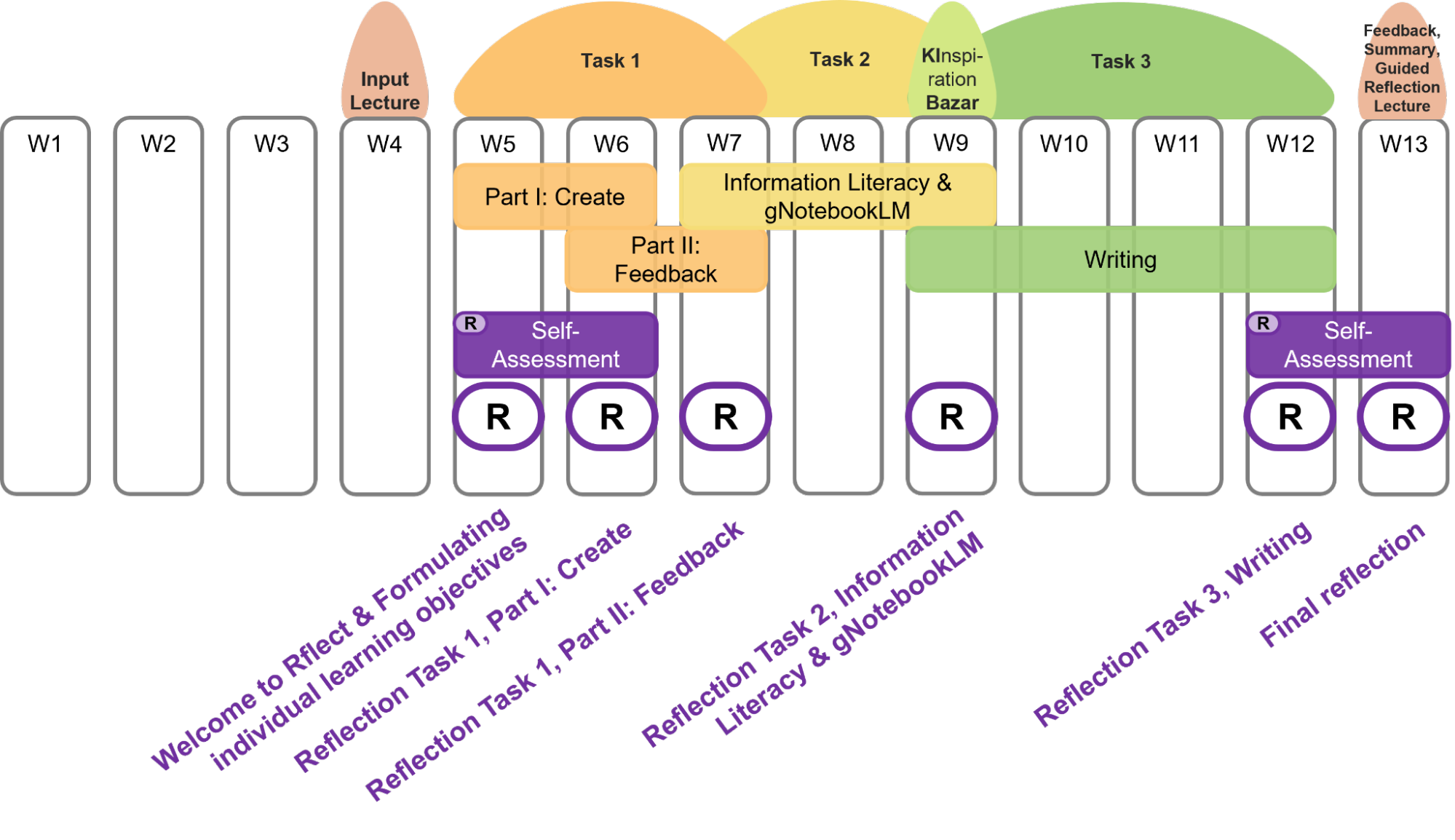
The semester at a glance: 3 course tasks interwoven with weekly reflections (R), bookended by a self-assessment repeated in weeks 5 and 12.
Midway through the semester, students were asked to give feedback on each other’s writing, and the instructions said nothing about whether AI was permitted. Some students pasted a classmate’s text into a chatbot, posted the output and considered the job done. Then the reflection questions landed: How did you produce your feedback? Do you think the feedback you received was written by an AI? How could you tell? How does it feel receiving feedback from a machine? “That’s the moment, alone with themselves, where they go: oops,” Sudau says. No rule was broken, but no rule was needed. The students had run the experiment on themselves and understood the result.
“It’s your responsibility to choose whether or not you use AI – how, and whether you declare it.” — Manuel Sudau, addressing students in the World Food System course
The ETH team, meanwhile, see completion, time spent per question and AI-generated summaries of emerging themes. (Tracking 100 students’ weekly reflections by hand would have swallowed more staff time than the course has.) Each question is configurable as private to the student, shared with the lecturer or shared with the class. Students wrote more candidly when they knew an answer would stay private.
Student outcomes: 95% completion and measurable competence gains
- 95% of participating students completed the full semester of roughly 15 activities.
- Time invested ranged from 20 minutes in total to one student’s two and a half hours. Students chose their own depth and stayed engaged at both ends – engagement at scale did not require uniformity.
- The pre and post self-assessments (86 completions in October, 84 in December) showed self-reported gains across nearly all nine dimensions, with the clearest movement in critical evaluation of AI output – the competence the exercise most deliberately provoked.
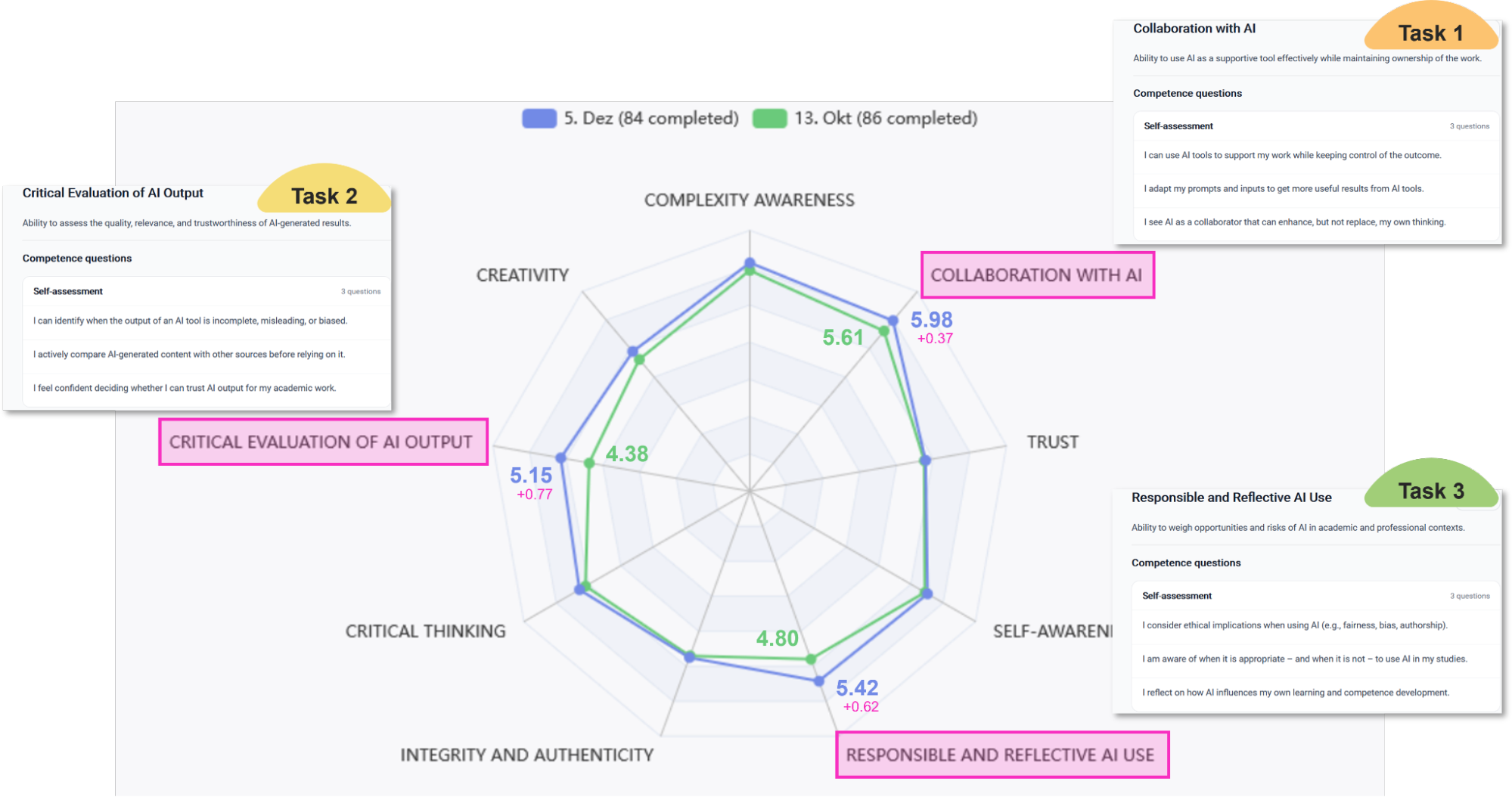
Students’ self-assessed development across 9 competences, measured in October (86 responses) and December (84 responses). The largest gain was in critical evaluation of AI output (+0.77).
However, the qualitative findings carried at least as much weight inside the department. The reflections gave the ETH team a live window into how AI actually runs through first-year study habits. Wolf and Sudau could read a week’s answers and adjust the next session; with a cohort they otherwise meet twice, that feedback loop had never existed before.
Key takeaway: Pilots like this don’t prove that reflection works – they prove your students will do it, with measurable impacts on their learning process.
Scaling implementation: from one course to a curriculum
The pilot sits inside a much larger project. The Department of Environmental Systems Science at ETH is two and a half years into a participatory revision of its two study programmes, with a first cohort planned for autumn 2028. One of its core commitments is structurally embedded student-centred learning: a mandatory course each semester carrying reflection activities, anchored by a self-assessment repeated every semester, so students accumulate a longitudinal picture of their own development.
The World Food System pilot was the deliberate first test of that architecture – to “create experiences that we then can present,” as Sudau describes the strategy. “This is a hypothesis I have. This is an experiment I did. This is what I found. And based on this I suggest that we now scale it up.”
This pattern – piloting at course level before committing at programme level – is one Rflect now sees repeatedly. At ETH, Wolf is seeding the approach in a second department, the Department of Health Sciences and Technology.
Of course, there are obstacles: licensing costs sit awkwardly in budgets built for personnel, results don’t transfer automatically between federally structured departments and compliance frameworks for working with a startup remain genuinely hard for public institutions. A pilot doesn’t dissolve any of that. But it does give the institution a result to organise around: 100 students actively engaged, a process that proved straightforward to run, and lecturers who gained continuous insight into how students were progressing – and how they were experiencing their learning – throughout the semester. For early adopter educators, that shifts the conversation from whether to how. It also points to something more fundamental: the future of learning is not just about giving students better tools, but about giving them greater ownership of their own learning journey.
Key takeaway: AI literacy will not be the last competence universities are asked to teach faster than their curricula can formally absorb. The ETH pilot offers a repeatable method for that gap: design the experience, ask the right question at the right moment and let the students build the judgement themselves. A well-timed question scales better than a well-written guideline – and a student who has learned to ask it of themselves will keep asking long after the course is over.